
"coffee tree yield"
4000 article(s) found

Four major cultivation systems of Ethiopian coffee analyze in detail how Ethiopian coffee is cultivated.
Forest coffee (Forest Coffee): wild coffee, which accounts for 10% of Ethiopia's national output, is distributed in the wild coffee forest areas of the west and southwest, also known as the Kafa forest. The dense trees here provide the most natural shade for coffee trees and do not need manual care. Mother Earth is in charge of birth, aging, sickness and death, and coffee farmers can go directly to the woodland to harvest. Hansen

Arabian coffee with dry citric acid flavor
[Caturra] A mutant of Kaddura species Bourbon. It was first found in Brazil and began to be planted for commercial use in Minas Gerais, Brazil in 1937. The taste is sour with lemon or citrus taste, but it is not as sweet as Typica and Bourbon in terms of sweetness, because the sweetness of Caturra depends on the number and dosage of fertilizer applied by the grower. It has high production capacity, but it is necessary to maintain production capacity.

Ethiopian coffee began to subdivide the varieties of Jiulumi, Degas and Walliso, respectively.
Ethiopian coffee varieties are often described as family heirlooms in recognition of their long history and to distinguish Ethiopia's production environment from other coffee producers that identify themselves as technology. Although Ethiopia has many mountain forests filled with wild coffee, most of the coffee grown and harvested for export today is selected or grown in some form. Essel out
Ethiopian coffee began to be subdivided into varieties of Jiulumi, Degas and Walliso.
Ethiopian coffee varieties are often described as family heirlooms in recognition of their long history and to distinguish Ethiopia's production environment from other coffee producers that identify themselves as technology. Although Ethiopia has many mountain forests filled with wild coffee, most of the coffee grown and harvested for export today is selected or grown in some form. Essel out

Development status and derivation of Robusta coffee beans
Https://baike.baidu.com/item/ Robusta / 4878176?fr=aladdin Robusta species (Latin name Coffee Robusta Linden), one of the most important coffee tree varieties in the world. The leaf rust-resistant varieties found in Congo in Africa have stronger disease resistance than Arabica. Different growth environments: coffee beans grown in Arabica

A brief introduction to the History and Culture of the Origin and Development of Katim's Fine Coffee beans
Many chopped beans, adzuki beans and bad beans still have a lot of defective beans after drying, so we hand-picked them on the spot and finally left 9 kilograms of qualified beans. By this time, most of the morning has passed, of course, if it is used to make instant coffee or general commercial beans, high-yield catimor is a good choice, but if you want to find Yunnan specialty coffee, then

Detailed analysis of forest and semi-forest system of four major cultivation systems of Ethiopian coffee
Forest coffee (Forest Coffee): wild coffee, which accounts for 10% of Ethiopia's national output, is distributed in the wild coffee forest areas of the west and southwest, also known as the Kafa forest. The dense trees here provide the most natural shade for coffee trees and do not need manual care. Mother Earth is in charge of birth, aging, sickness and death, and coffee farmers can go directly to the woodland to harvest. Hansen

Beginners must see the introduction to coffee knowledge _ basic knowledge of coffee _ complete knowledge of coffee theory
Professional coffee knowledge exchange more coffee bean information Please follow the coffee workshop (Wechat official account cafe_style) many people think that coffee is the black powder in cans, but they forget that coffee is actually a seasonal and periodic fruit that grows on trees. It needs to undergo a series of complex manual polishing before it can be turned into a warm drink with a strong fragrance. one

Katim Fine Coffee Bean Varieties Planting Location Climate Elevation Profile
1. The state-owned Lujiang Farm in Baoshan City was planted in March 1991 with an area of 12.6 mu. There was no shade and irrigation once in dry season. The management level and fertilizer application level were medium. The fruit was produced in 1993. The average yield per mu in 93/94 was 75 kg. The average yield per mu in 94/95 was 350 kg. The average yield per mu in 95/96 was 225 kg. The average yield per mu in three years was 217 kg. The yield was 36% higher than that of Tibika and Bobang (Tibika and Bobang

A brief introduction to the description of flavor, taste and aroma characteristics of extremely rare bourbon boutique coffee beans
Yellow bourbon "Bourbon Amarello" is a bourbon variety of yellow skin unique to the state of Sao Paulo, Brazil. Coffee fruits usually turn red when ripe, but yellow bourbon does not turn red when ripe, so it is named after orange. Huang Bourbon became a boutique coffee because he almost won the top three prizes in "CoE" (Cup of Excellence, Chinese name: extraordinary Cup).

The Development trend of Fine Coffee beans and Fine Coffee
Boutique coffee beans 1. High-quality coffee beans must be excellent varieties, such as the original bourbon species, mocha species and Tippica species. The coffee beans produced by these trees have strange aroma and flavor, which is far from that of other tree species, but the relative yield is low. in recent years, in pursuit of disease and insect resistance and yield improvement, there are many improved tree species, such as Kenya to promote high yield.

Flavor description of Katim Coffee beans introduction to the varieties of manor treatment
Coffee is a long-term economic crop, woodland reclamation must be long-term planning, good planning, before reclamation must do a good job of road, shed, fertilizer pool design. When the woodland is reclaimed, shade trees should be selected so that the coffee woodland after planting has 3040% shade, and then adjusted to 2030%. The planning and reclamation of horizontal terraces must be done well in the planning and design, which is the primary work of soil and water conservation.

Why Yunnan is suitable for planting Coffee trees Latin American Martinique Coffee
In terms of climatic conditions, the long light time in southern Yunnan is conducive to plant growth and photosynthesis, and the large temperature difference between day and night and low temperature at night are conducive to the accumulation of coffee nutrients. Therefore, the effective nutrients of Yunnan small-grain coffee are higher than those of other foreign coffee varieties. Small seed coffee is easy to be infected with rust, and the yield and quality of embroidery disease are deeply affected. The hot areas of Yunnan are composed of

Katim Coffee Bean Flavor description introduction to the manor of the region where the varieties are produced
Katim Coffee Bean Flavor description Variety production area treatment Manor introduces the field management measures suitable for the management of general small-grain coffee. Propagation method: adopt seed propagation, select 5-year-old fine mother tree, harvest fully mature, fruit shape is normal, full, size is basically the same, with two-seed fruit as seed, using sand bed to promote germination, plastic bag seedling. Selection of suitable forest land
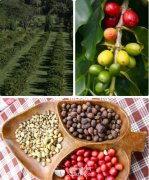
Coffee classification
Special classification system of coffee: 1. Subgenus Coffea: 2. Malagasy coffee subgenus: 3. Subgenus Pala Coffee: 4. Age coffee subgenus: a, red coffee group: B, thick-skinned coffee group: C, Mozambican coffee group: d, black fruit coffee group E, dwarf coffee group: red fruit coffee group: a) Arabica species: Tibica varieties: (Tp)

Starting from Coffee cultivation-the upcoming planting and Environmental problems in Coffee growing areas in Yunnan
Professional coffee knowledge exchange more coffee bean information please follow the coffee workshop (Wechat official account cafe_style) A coffee tree bears fruit several times a year. Coffee is one of the agricultural products, and its yield varies by region, climate, altitude, planting mode and other factors. From coffee sweeping the world to becoming the most popular drink in western countries, the whole world

Introduction to the characteristics of Yunnan Tieka Coffee Flavor Manor
The so-called new variety actually refers to catimor, which is a hybrid of timor and Arabica from the Roberta family. Compared with the old variety, it lacks rich aroma and taste, and has a relatively shallow smell of grass and soil, but it has the advantages of resistance to diseases and insect pests, easy management and high yield, and its yield per mu is up to 350kg, which is twice that of the old variety.

Coffee classification system
Special classification system of coffee: 1. Subgenus Coffea: 2. Malagasy coffee subgenus: 3. Subgenus Pala Coffee: 4. Age coffee subgenus: a, red coffee group: B, thick-skinned coffee group: C, Mozambican coffee group: d, black fruit coffee group E, dwarf coffee group: red fruit coffee group: a) Arabica species: Tibica varieties: (Tp)

Coffee Variety Information | Arabica Coffee Bean Variety introduction Arabica Coffee Variety introduction
Coffee tree is a flowering plant of the genus Coffea of Rubiaceae. At present, there are about 120 species, ranging from small shrubs to 18-meter-tall trees. Wild coffee species grow irregularly in the tropics, and new species are still being discovered. Strictly speaking, there are only two major species of coffee that are cultivated to produce coffee: Arabica coffee (Arabica) and Canifra.

Description of characteristics and Flavor of Iron pickup Coffee introduction of manor varieties in grinding scale production area
If it is used to make instant coffee or general commercial beans, high-yielding catimor is a good choice, but if you want to look for Yunnan specialty coffee, then the old variety Tieka has become the first because of its congenital excellent gene.